We have written this privacy policy (version 31.01.2026-112916121) in order to explain to you, in accordance with the provisions of the General Data Protection Regulation (EU) 2016/679 and applicable national laws, which personal data (data for short) we as the controller – and the processors commissioned by us (e.g. providers) – process, will process in the future and what legal options you have. The terms used are to be considered gender-neutral.
In short: We provide you with comprehensive information about any of your personal data we process.
Privacy policies usually sound very technical and use legal terminology. However, this privacy policy is intended to describe the most important things to you as simply and transparently as possible. So long as it aids transparency, technical terms are explained in a reader-friendly manner, links to further information are provided and graphics are used. We are thus informing in clear and simple language that we only process personal data in the context of our business activities if there is a legal basis for it. This is certainly not possible with brief, unclear and legal-technical statements, as is often standard on the internet when it comes to data protection. I hope you find the following explanations interesting and informative. Maybe you will also find some information that you have not been familiar with.
If you still have questions, we kindly ask you to contact the responsible body named below or in the imprint, follow the existing links and look at further information on third-party sites. You can of course also find our contact details in the imprint.
This privacy policy applies to all personal data processed by our company and to all personal data processed by companies commissioned by us (processors). With the term personal data, we refer to information within the meaning of Article 4 No. 1 GDPR, such as the name, email address and postal address of a person. The processing of personal data ensures that we can offer and invoice our services and products, be it online or offline. The scope of this privacy policy includes:
In short: This privacy policy applies to all areas in which personal data is processed in a structured manner by the company via the channels mentioned. Should we enter into legal relations with you outside of these channels, we will inform you separately if necessary.
In the following privacy policy, we provide you with transparent information on the legal principles and regulations, i.e. the legal bases of the General Data Protection Regulation, which enable us to process personal data.
Whenever EU law is concerned, we refer to REGULATION (EU) 2016/679 OF THE EUROPEAN PARLIAMENT AND OF THE COUNCIL of April 27, 2016. You can of course access the General Data Protection Regulation of the EU online at EUR-Lex, the gateway to EU law, at https://eur-lex.europa.eu/legal-content/EN/TXT/?uri=celex%3A32016R0679.
We only process your data if at least one of the following conditions applies:
Other conditions such as making recordings in the interest of the public, the exercise of official authority as well as the protection of vital interests do not usually occur with us. Should such a legal basis be relevant, it will be disclosed in the appropriate place.
In addition to the EU regulation, national laws also apply:
Should other regional or national laws apply, we will inform you about them in the following sections.
If you have any questions about data protection or the processing of personal data, you will find below the contact details of the controller in accordance with Article 4(7) of the EU General Data Protection Regulation (GDPR):
Hannes Dunhofer
E-Mail: teran.barat@gmail.com
Phone: +43 6644138664
Company details: https://villateran.com/de/pages/impressum
It is a general criterion for us to store personal data only for as long as is absolutely necessary for the provision of our services and products. This means that we delete personal data as soon as any reason for the data processing no longer exists. In some cases, we are legally obliged to keep certain data stored even after the original purpose no longer exists, such as for accounting purposes.
If you want your data to be deleted or if you want to revoke your consent to data processing, the data will be deleted as soon as possible, provided there is no obligation to continue its storage.
We will inform you below about the specific duration of the respective data processing, provided we have further information.
In accordance with Articles 13, 14 of the GDPR, we inform you about the following rights you have to ensure fair and transparent processing of data:
In short: you have rights – do not hesitate to contact the responsible party listed above with us!
If you believe that the processing of your data violates data protection law or your data protection rights have been violated in any other way, you can complain to the supervisory authority. For Austria, this is the data protection authority, whose website can be found at https://www.dsb.gv.at/. In Germany, there is a data protection officer for each federal state. For more information, you can contact the Federal Commissioner for Data Protection and Freedom of Information (BfDI). The following local data protection authority is responsible for our company:
Manager:Dr. Matthias Schmidl
Address: Barichgasse 40-42, 1030 Wien
Phone number.: +43 1 52 152-0
E-mail address:
dsb@dsb.gv.at
Website:
https://www.dsb.gv.at/
|
Cookies Overview
👥 Affected parties: visitors to the website 🤝 Purpose: depending on the respective cookie. You can find out more details below or from the software manufacturer that sets the cookie. 📓 Processed data: depends on the cookie used. More details can be found below or from the manufacturer of the software that sets the cookie. 📅 Storage duration: can vary from hours to years, depending on the respective cookie ⚖️ Legal basis: Art. 6 para. 1 lit. a GDPR (consent), Art. 6 para. 1 lit. f GDPR (legitimate interests) |
Our website uses HTTP-cookies to store user-specific data.
In the following we explain what cookies are and why they are used, so that you can better understand the following privacy policy.
Whenever you surf the Internet, you are using a browser. Common browsers are for example, Chrome, Safari, Firefox, Internet Explorer and Microsoft Edge. Most websites store small text-files in your browser. These files are called cookies.
It is important to note that cookies are very useful little helpers. Almost every website uses cookies. More precisely, these are HTTP cookies, as there are also other cookies for other uses. HTTP cookies are small files that our website stores on your computer. These cookie files are automatically placed into the cookie-folder, which is the “brain” of your browser. A cookie consists of a name and a value. Moreover, to define a cookie, one or multiple attributes must be specified.
Cookies store certain user data about you, such as language or personal page settings. When you re-open our website to visit again, your browser submits these “user-related” information back to our site. Thanks to cookies, our website knows who you are and offers you the settings you are familiar to. In some browsers, each cookie has its own file, while in others, such as Firefox, all cookies are stored in one single file.
The following graphic shows a possible interaction between a web browser such as Chrome and the web server. The web browser requests a website and receives a cookie back from the server. The browser then uses this again as soon as another page is requested.
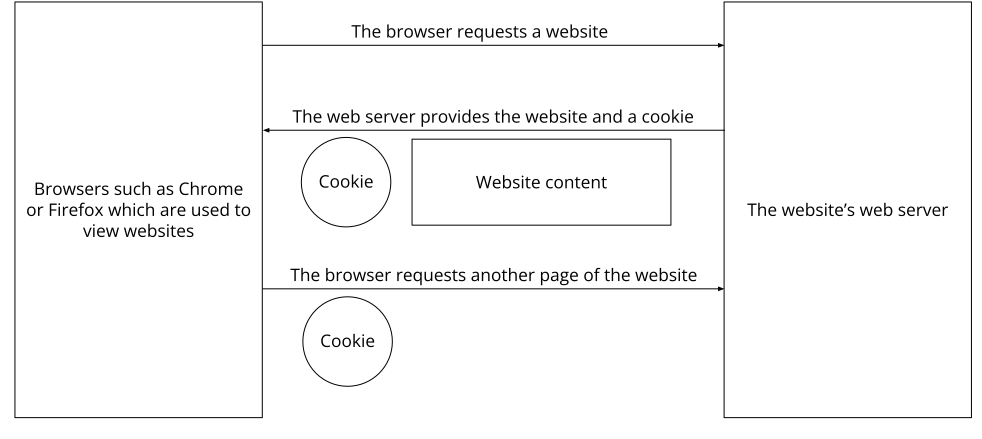
There are both first-party cookies and third-party cookies. First-party cookies are created directly by our site, while third-party cookies are created by partner-websites (e.g. Google Analytics). Each cookie must be evaluated individually, as each cookie stores different data. The expiry time of a cookie also varies from a few minutes to a few years. Cookies are not software programs and do not contain viruses, trojans or other malware. Cookies also cannot access your PC’s information.
This is an example of how cookie-files can look:
Name: _ga
Value: GA1.2.1326744211.152112916121-9
Purpose: Differentiation between website visitors
Expiry date: after 2 years
A browser should support these minimum sizes:
The exact cookies that we use, depend on the used services, which will be outlined in the following sections of this privacy policy. Firstly, we will briefly focus on the different types of HTTP-cookies.
There are 4 different types of cookies:
Essential cookies
These cookies are necessary to ensure the basic functions of a website. They are needed when a user for example puts a product into their shopping cart, then continues surfing on different websites and comes back later in order to proceed to the checkout. These cookies ensure the shopping cart does not get deleted, even if the user closes their browser window.
Purposive cookies
These cookies collect information about user behaviour and whether the user receives any error messages. Furthermore, these cookies record the website’s loading time as well as its behaviour in different browsers.
Target-orientated cookies
These cookies ensure better user-friendliness. Thus, information such as previously entered locations, fonts sizes or data in forms stay stored.
Advertising cookies
These cookies are also known as targeting cookies. They serve the purpose of delivering customised advertisements to the user. This can be very practical, but also rather annoying.
Upon your first visit to a website you are usually asked which of these cookie-types you want to accept. Furthermore, this decision will of course also be stored in a cookie.
If you want to learn more about cookies and do not mind technical documentation, we recommend https://tools.ietf.org/html/rfc6265, the Request for Comments of the Internet Engineering Task Force (IETF) called “HTTP State Management Mechanism”.
The purpose ultimately depends on the respective cookie. You can find out more details below or from the software manufacturer that sets the cookie.
Cookies are little helpers for a wide variety of tasks. Unfortunately, it is not possible to tell which data is generally stored in cookies, but in the privacy policy below we will inform you on what data is processed or stored.
The storage period depends on the respective cookie and is further specified below. Some cookies are erased after less than an hour, while others can remain on a computer for several years.
You can also influence the storage duration yourself. You can manually erase all cookies at any time in your browser (also see “Right of objection” below). Furthermore, the latest instance cookies based on consent will be erased is after you withdraw your consent. The legality of storage will remain unaffected until then.
You can decide for yourself how and whether you want to use cookies. Regardless of which service or website the cookies originate from, you always have the option of erasing, deactivating or only partially accepting cookies. You can for example block third-party cookies but allow all other cookies.
If you want to find out which cookies have been stored in your browser, or if you want to change or erase cookie settings, you can find this option in your browser settings:
Chrome: Clear, enable and manage cookies in Chrome
Safari: Manage cookies and website data in Safari
Firefox: Clear cookies and site data in Firefox
Internet Explorer: Delete and manage cookies
Microsoft Edge: Delete cookies in Microsoft Edge
If you generally do not want cookies, you can set up your browser in a way to notify you whenever a cookie is about to be set. This gives you the opportunity to manually decide to either permit or deny the placement of every single cookie. This procedure varies depending on the browser. Therefore, it might be best for you to search for the instructions in Google. If you are using Chrome, you could for example put the search term “delete cookies Chrome” or “deactivate cookies Chrome” into Google.
The so-called “cookie directive” has existed since 2009. It states that the storage of cookies requires your consent (Article 6 Paragraph 1 lit. a GDPR). Within countries of the EU, however, the reactions to these guidelines still vary greatly. In Austria, however, this directive was implemented in Section 165 (3) of the Telecommunications Act (2021). In Germany, the cookie guidelines have not been implemented as national law. Instead, this guideline was largely implemented in Section 15 (3) of the Telemedia Act (TMG), which has been replaced by the Digital Services Act (DSA) since May 2024.
For absolutely necessary cookies, even if no consent has been given, there are legitimate interests (Article 6 (1) (f) GDPR), which in most cases are of an economic nature. We want to offer our visitors a pleasant user experience on our website. For this, certain cookies often are absolutely necessary.
This is exclusively done with your consent, unless absolutely necessary cookies are used. The legal basis for this is Article 6 (1) (a) of the GDPR.
In the following sections you will find more detail on the use of cookies, provided the used software does use cookies.
|
Contact Form Summary
👥 Data Subjects: Website visitors who enter data into a contact form 🤝 Purpose: Processing inquiries and communication in the context of pre-contractual measures or existing interest in our services 📓 Processed Data: Name, email address, phone number (if provided), message content, IP address, technical metadata (e.g., timestamp, browser information) 📅 Storage Duration: Data will be deleted as soon as it is no longer necessary for processing the inquiry and no legal retention obligations apply. ⚖️ Legal Bases: Consent (Art. 6 para. 1 lit. a GDPR), Legitimate Interest (Art. 6 para. 1 lit. f GDPR), Contract or pre-contractual measures (Art. 6 para. 1 lit. b GDPR) |
A contact form is a web form you can fill out on our website to get in touch with us easily. Typically, personal data such as your name, email address, and your message are transmitted to us. This information helps us respond to your inquiries more effectively and contact you directly.
We offer a contact form to make it quick and easy for you to communicate with us. Whether you have questions about our services, want to give feedback, or have other concerns – the contact form allows you to reach out directly. The information you provide will be used solely to process your inquiry and to contact you. If the inquiry leads to further steps, such as providing an offer or entering into a contract, we may also use the data for those purposes.
The specific data we process depends on the information you provide in the contact form. In general, this includes:
This information helps us understand and respond to your inquiry more efficiently.
We store contact form data only as long as necessary to process your inquiry. If a business relationship arises, the same retention periods as for customer data apply. In certain cases (e.g., legal disputes), longer retention periods may be required. Of course, we do not share your data with third parties without your explicit consent.
The legal bases for processing your data via the contact form are Art. 6 para. 1 lit. a GDPR (consent – by submitting the form), Art. 6 para. 1 lit. b GDPR (pre-contractual measures), and Art. 6 para. 1 lit. f GDPR (legitimate interest – efficient communication and organization of inquiries). If you voluntarily provide special categories of personal data, processing is based on Art. 9 para. 2 lit. a GDPR (explicit consent).
|
Web hosting Overview
👥 Affected parties: visitors to the website 📓 Purpose: professional hosting of the website and security of operations 🤝 Processed data: IP address, time of website visit, browser used and other data. You can find more details on this below or at the respective web hosting provider. 📅 Storage period: dependent on the respective provider, but usually 2 weeks ⚖️ Legal basis: Art. 6 para. 1 lit. f GDPR (legitimate interests) |
Every time you visit a website nowadays, certain information – including personal data – is automatically created and stored, including on this website. This data should be processed as sparingly as possible, and only with good reason. By website, we mean the entirety of all websites on your domain, i.e. everything from the homepage to the very last subpage (like this one here). By domain we mean example.uk or examplepage.com.
When you want to view a website on a screen, you use a program called a web browser. You probably know the names of some web browsers: Google Chrome, Microsoft Edge, Mozilla Firefox, and Apple Safari.
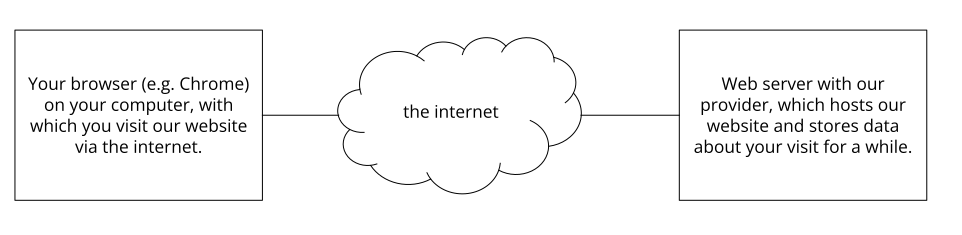
The web browser has to connect to another computer which stores the website’s code: the web server. Operating a web server is complicated and time-consuming, which is why this is usually done by professional providers. They offer web hosting and thus ensure the reliable and flawless storage of website data.
Whenever the browser on your computer establishes a connection (desktop, laptop, smartphone) and whenever data is being transferred to and from the web server, personal data may be processed. After all, your computer stores data, and the web server also has to retain the data for a period of time in order to ensure it can operate properly.
Illustration:
The purposes of data processing are:
Even while you are visiting our website, our web server, that is the computer on which this website is saved, usually automatically saves data such as
Generally, the data mentioned above are stored for two weeks and are then automatically deleted. We do not pass these data on to others, but we cannot rule out the possibility that this data may be viewed by the authorities in the event of illegal conduct.
In short: Your visit is logged by our provider (company that runs our website on special computers (servers)), but we do not pass on your data without your consent!
The lawfulness of processing personal data in the context of web hosting is justified in Art. 6 para. 1 lit. f GDPR (safeguarding of legitimate interests), as the use of professional hosting with a provider is necessary to present the company in a safe and user-friendly manner on the internet, as well as to have the ability to track any attacks and claims, if necessary.
We use the web hosting provider Netlify for our website. The provider of this service is the American company Netlify Inc., 2325 3rd Street, Suite 29, San Francisco, CA 94104, USA.
Netlify processes data from you, among other things, in the USA. Netlify is an active participant in the EU-US Data Privacy Framework, which regulates the correct and secure transfer of personal data from EU citizens to the USA. More information can be found at https://commission.europa.eu/document/fa09cbad-dd7d-4684-ae60-be03fcb0fddf_en.
Additionally, Netlify uses so-called Standard Contractual Clauses (Article 46(2) and (3) GDPR). Standard Contractual Clauses (SCC) are template clauses provided by the EU Commission and are designed to ensure that your data complies with European data protection standards, even when transferred and stored in third countries (such as the USA). Through the EU-US Data Privacy Framework and the Standard Contractual Clauses, Netlify commits to maintaining the European data protection level when processing your relevant data, even if the data is stored, processed, and managed in the USA. These clauses are based on an implementing decision of the EU Commission. You can find the decision and the corresponding Standard Contractual Clauses here: https://ec.europa.eu/commission/presscorner/detail/en/ip_21_2847.
Netlify holds a contract on commissioned processing in accordance with Art. 28 GDPA, which acts as the data protection law basis for our customer relationship with Netlify. The content of this contract refers to the EU standard contractual clauses. You can find it here: https://www.netlify.com/v3/static/pdf/netlify-dpa.pdf.
You can find out more about the data that is processed by using Netlify in their Privacy Policy at https://www.netlify.com/privacy/.
We always strive to make our privacy policy as clear and comprehensible as possible. However, this is not always easy, especially when it comes to technical and legal matters. It is often sensible to use legal terms (such as ‘personal data)’ or certain technical terms (such as ‘cookies’ or ‘IP address’). But we don’t want to use such terms without any explanation. This is why you will find an alphabetical list of important terms used below. These are terms we may not yet have sufficiently explained in the privacy policy. In case we have adopted any of these terms from the GDPR which are definitions, we will also list the GDPR texts here and add our own further explanations if necessary.
Definition according to Article 4 of the GDPR
For the purposes of this Regulation, the term means:
“processor” means a natural or legal person, public authority, agency or other body which processes personal data on behalf of the controller;
Explanation: As a company and a website owner, we are responsible for all your data we process (i. e. the ‘controller’). In addition to the controller, there may also be so-called processors. This includes any company or person who processes personal data on our behalf. In addition to service providers such as tax consultants, processors can also be hosting or cloud providers, payment or newsletter providers or large companies such as Google or Microsoft.
Definition according to Article 4 of the GDPR
For the purposes of this Regulation, the term means:
“consent” of the data subject means any freely given, specific, informed and unambiguous indication of the data subject’s wishes by which he or she, by a statement or by a clear affirmative action, signifies agreement to the processing of personal data relating to him or her;
Explanation: With websites, such consent is usually given via a cookie consent tool. You’ve most certainly come across these. Whenever you visit a website for the first time, you will usually be asked via a banner whether you agree or consent to the data processing. You can usually also make individual settings and thus decide for yourself which level of data processing you want to allow. If you do not give your consent, no personal data may be processed. Consent can of course also be given in writing, i.e. not via a tool.
Definition according to Article 4 of the GDPR
For the purposes of this Regulation, the term means:
“personenal data” means any information relating to an identified or identifiable natural person (‘data subject’); an identifiable natural person is one who can be identified, directly or indirectly, in particular by reference to an identifier such as a name, an identification number, location data, an online identifier or to one or more factors specific to the physical, physiological, genetic, mental, economic, cultural or social identity of that natural person;
Explanation: Personal data is all data that can identify you as a person. This is usually data such as:
According to the European Court of Justice (ECJ), your IP address is also personal data. IT experts can use your IP address to determine at least the approximate location of your device and subsequently your location as the connection owner. Therefore, storing an IP address also requires a legal basis within the scope of the GDPR. There are also so-called “special categories” of personal data, which are particularly worthy of protection. These include:
Definition according to Article 4 of the GDPR
For the purposes of this Regulation, the term means:
“Profiling” means any form of automated processing of personal data consisting of the use of personal data to evaluate certain personal aspects relating to a natural person, in particular to analyse or predict aspects concerning that natural person’s performance at work, economic situation, health, personal preferences, interests, reliability, behaviour, location or movements;
Explanation: Profiling collects various personal data about an individual in order to learn more about that individual. On the internet, profiling is often used for advertising purposes or for credit checks. Web and advertising analysis programs e. g. collect data about your behaviour and interests on a website. This results in a special user profile that can be used to target advertising to specific target groups.
Definition according to Article 4 of the GDPR
For the purposes of this Regulation, the term means:
“controller” means the natural or legal person, public authority, agency or other body which, alone or jointly with others, determines the purposes and means of the processing of personal data; where the purposes and means of such processing are determined by Union or Member State law, the controller or the specific criteria for its nomination may be provided for by Union or Member State law;
Explanation: In our example, we are responsible for the processing of your personal data and are therefore the “controller”. If we pass on collected data to other service providers for processing, they are considered “contract processors”. For this, a “Data Processing Agreement (DPA)” must be concluded.
Definition according to Article 4 of the GDPR
For the purposes of this Regulation, the term means:
“processing” means any operation or set of operations which is performed on personal data or on sets of personal data, whether or not by automated means, such as collection, recording, organisation, structuring, storage, adaptation or alteration, retrieval, consultation, use, disclosure by transmission, dissemination or otherwise making available, alignment or combination, restriction, erasure or destruction;
Note: When we talk about processing in our Privacy Policy, we talk about any type of data processing. As mentioned above in the original GDPR declaration, this includes not only the collection but also the storage and processing of data.
All texts are copyrighted
Source: Privacy Policy created with the Privacy Policy Generator for Austria by AdSimple